Foundation
This document refers to the version 26.09.15
Developers: about foundation-multitenancy-config
This version has "breaking changes" All projects and modules using this version that has foundation-multitenant-config dependency should use at least the version 22.06.27 or newer. See changelog "breaking changes" for more details.
Developers: k3s v1.36.2 update guide
Follow the steps below to update k3s to version 1.36 in Foundation:
-
Run the Foundation configuration command:
-
Select the configuration file currently used by Foundation.
-
When prompted with:
entery. -
For the following configuration prompts, press
Enterto keep the current/default values. -
When prompted with:
enteryto updatek3s. -
Continue pressing
Enterto keep the current/default values for the remaining prompts until the configuration process is complete. -
After the process finishes, verify that the expected
k3sversion is installed:
Offline installation
If your server does not have internet access, you can use the offline k3s installation package instead.
For latest recommended version check this link.
Introduction
Installing and maintaining systems is complex and requires a lot of effort from the IT staff. In most cases, the scenario is composed of several systems, each with its specific requirements and needs for uptime, configuration, monitoring, fault tolerance, computational resources, etc. Due to this diversity of requirements, the IT team is obliged to train and manage each system individually, with low reuse of this knowledge and computational resources.
Based on this vision and always striving for excellence, Synchro presents the Foundation. As a result of the most advanced research applied in software development technology, Synchro Foundation is a middle-ware that unifies the management of all systems, facilitating installation, configuration, monitoring and updating.
In response to the increasingly demanding scenario regarding the complexity of solutions, such as the need for updating due to legal changes, integration, management and visibility of large volumes of data, low response time in the execution of processes. Foundation is the Synchro middleware platform that meets all these needs and brings benefits to the On-Premises environment that are currently only possible in the cloud.
How it works?
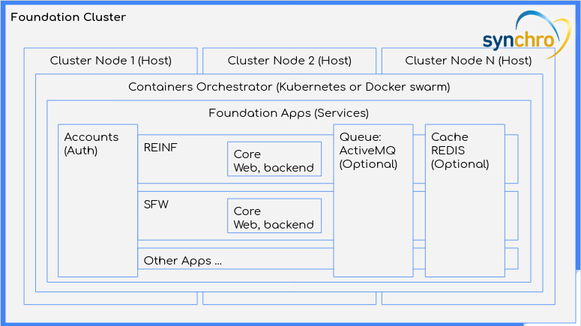
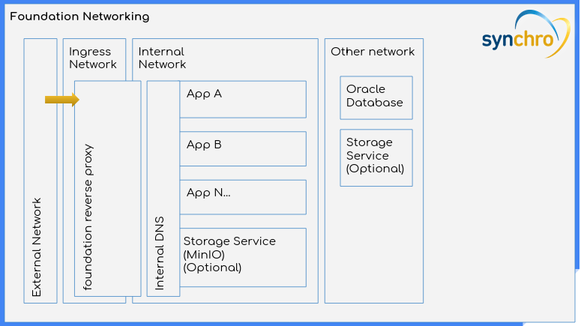
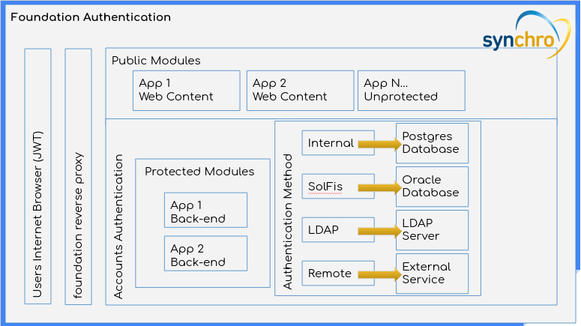

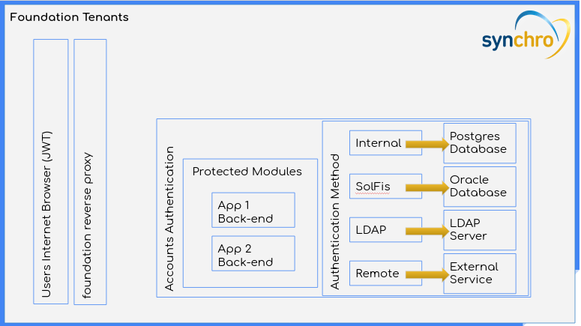
Foundation creates a cluster of one or more servers and exposes a unified interface to the product modules. That way, you can run more than one product on the same infrastructure. The middleware manages the distribution of the computational load among the nodes of the cluster. From this abstraction, instead of managing each product on each host individually, management becomes the middleware level, which is much simpler, as it is done through an intuitive and easy to use web interface.
The Foundation is installed on the servers forming a cluster and, from there, the product modules are installed at the Foundation, which leads to the unification of the management process of Synchro systems. It is important to highlight that this unification brings a lot of time and effort to the IT management, as it reduces the diversity of characteristics to be met and simplifies all the work of keeping the product modules in production.
In practice this means that, for example, REINF can be installed and managed on the same infrastructure as the Web Fiscal Solution (EFD PIS / COFINS and ECF), reusing computing resources and making configurations, updates and maintenance following the same procedures.
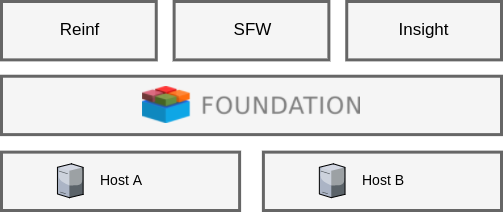
Another practical benefit is the notification of new versions of the product modules directly on the Foundation's interface and automated management of the upgrade process allowing it to be done in one click, promoting the approved version for automated production, drastically reducing the risks generated by the work manual.
The installation of Synchro Foundation is very simple, as it is done using the package managers present in all Linux distributions. After all, this is what they were designed for and work very well.
From there, all interaction of the IT professional with the Synchro Foundation occurs through a web interface. Through this interface it is possible to install modules, monitor resource consumption, obtain logs and perform updates. There is also a text mode tool that has the same functionality as the web interface.